
Our own calibrated surfaces
We fit exchange quotes across strikes and expiries into a consistent view of each market.
Crypto options analytics
Derivasys builds live volatility surfaces from exchange quotes. Compare pricing across seven crypto markets, track changes in volatility and skew, and inspect the quality of the underlying data.
Coverage BTC · ETH · SOL · XRP · HYPE · AVAX · TRX
DELAYED · OLDEST DATA 21S AGO · AS OF
Why Derivasys
We fit exchange quotes across strikes and expiries into a consistent view of each market.
Quote freshness, venue marks and calibration diagnostics show how well each surface is supported.
Track changes in ATM volatility, skew and term structure across markets and maturities.
Inside the dashboard
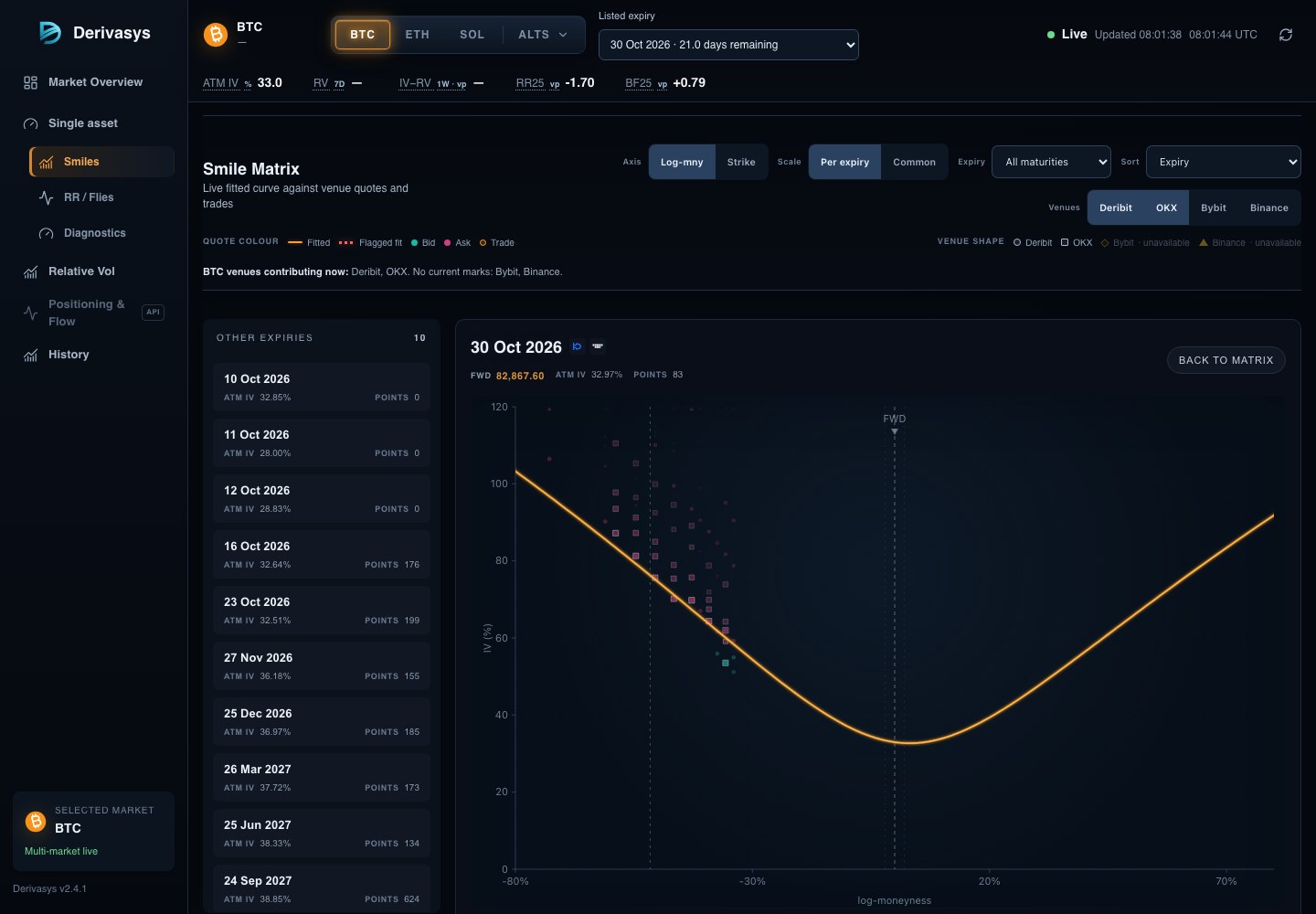
Bid and ask marks show where exchange quotes sit around the fit.
The amber line is our calibrated smile for one expiry.
Venue availability and quote counts show the market data behind the curve.
BTC dashboard capture · · Daily capture overdue. Select the image to enlarge.
Daily and weekly analysis
Solana–Bitcoin 1W ATM IV level dispersion measured 14.65 volatility points at the October 12 cutoff: Solana 1W ATM IV was 46.88%, versus Bitcoin 1W ATM IV at 32.23%, according to Derivasys data. The cross-sectional range across Bitcoin, Ether and Solana was unusually tight within the supplied matching history. Unequal daily ATM IV declines accompanied that convergence, while one-week skew dispersion widened.
The 1W RR25 signed spread (AVAX minus TRX) is +1.18 vol points, a change of -2.47 vol points between the stored surface endpoints.
Bitcoin's 1W BF25 fell 0.29 volatility points to 1.57 points between the October 11 and October 12 cutoffs, reducing butterfly convexity. Average wing implied volatility narrowed relative to ATM, while supporting readings showed a smaller put-side skew advantage and limited daily movement in front-end ATM volatility.
Continued SOL purchases by a publicly listed treasury firm may affect perceptions of corporate demand for SOL, while shrinking weekly buying raises questions about the pace of that demand.
Why it matters: Continued SOL purchases by a publicly listed treasury firm may affect perceptions of corporate demand for SOL, while shrinking weekly buying raises questions about the pace of that demand.
The Nasdaq-listed company now holds about 2.59 million SOL, but its weekly purchases keep shrinking.
Evernorth’s Nasdaq debut after its SPAC merger makes a listed XRP treasury vehicle available to investors. The reported investor cash-outs and lower value of its XRP holdings may shape views of demand and the risks of corporate crypto treasuries.
Why it matters: Evernorth’s Nasdaq debut after its SPAC merger makes a listed XRP treasury vehicle available to investors. The reported investor cash-outs and lower value of its XRP holdings may shape views of demand and the risks of corporate crypto treasuries.
Evernorth's XRPN shares began trading Monday after its SPAC merger closed, but 80% of SPAC investors cashed out first and its XRP stash is worth roughly 40% less than at signing.
Reports of fund losses linked to a hardware-wallet reseller and an implant investigation raise potential supply-chain security concerns for self-custody users; the scope and cause remain under investigation.
Why it matters: Reports of fund losses linked to a hardware-wallet reseller and an implant investigation raise potential supply-chain security concerns for self-custody users; the scope and cause remain under investigation.
Ledger has reassured users after people who bought signing devices from a Malaysia-based reseller reported losing funds.
Checks automatically every 30 seconds while this tab is visible.
Editorial review is up to date. Checked 12 Oct 2026, 21:22 UTC.
Daily report context · 2026-10-12
Report cutoff: . Comparison snapshot: .
24-hour spot breadth: 0 higher, 7 lower, 0 flat, 0 unavailable. 7 of seven moved lower.
All seven 1W ATM IV daily changes
Volatility points
Current: 12 Oct 2026, 16:30 UTC
Previous: 11 Oct 2026, 16:30 UTC
The seven-asset measurement does not meet the stored quantitative prerequisites. IV qualification requires a common nonzero direction and at least 1.00 volatility points in every asset; publication also depends on materiality and editorial checks.
Historical eligibility: 19 complete observations; minimum 20. Unavailable: insufficient-history. Causality is not assessed.
For developers and quant teams
Evaluate structured surface, smile and risk data alongside the dashboard.
Beta WebSocket evaluation is available by request. REST behavior remains in testing, is supplied only under evaluator-specific terms, and is not generally available.